


- CONFERENCE
- FOR AUTHORS
- EDITORIAL POLICIES
- PROCEEDINGS
- PROGRAMME
- REGISTRATION
- CONTACT

229–30 October 2026.
Cultural Centre Osijek, Croatia

SCIENTIFIC ASSEMBLY OF SLAVONIA AND BARANJA
The Institute for Scientific and Artistic Research in Osijek of the Croatian Academy of Sciences and Arts, with the support of the Josip Juraj Strossmayer University of Osijek and under the patronage of the Government of the Republic of Croatia, is pleased to announce the second Scientific Assembly of Slavonia and Baranja. The conference welcomes original scientific contributions from a broad range of disciplines. All submitted papers undergo a double-blind peer-review process. Accepted papers are published in the Conference Proceedings.
The Scientific Assembly of Slavonia and Baranja serves as an interdisciplinary platform bringing together researchers, policymakers, public authorities, industry representatives, and other stakeholders to address key regional development challenges through keynote lectures, panel discussions, round tables, and peer-reviewed scientific contributions.
Held biennially, the conference promotes dialogue between science, public policy, and industry with the aim of generating evidence-based solutions that strengthen the economic resilience and long-term sustainable development of Slavonia and Baranja, thereby contributing to the prosperity of the Republic of Croatia.
The continued support of the Josip Juraj Strossmayer University of Osijek reflects the long-standing partnership between the University and the Croatian Academy of Sciences and Arts, reaffirming their shared commitment to scientific excellence, interdisciplinary collaboration, and the advancement of research in Eastern Croatia.

The support of the Josip Juraj Strossmayer University of Osijek for the Croatian Academy of Sciences and Arts in organizing the Scientific Assembly reflects a long-standing partnership, mutual recognition of scientific excellence, and a shared commitment to scientific excellence and the continued development of the regional research landscape.


The support of the City of Osijek and Osijek-Baranja County further highlights the strong partnership between the scientific community and local and regional government. It also reinforces the position of the City of Osijek and Osijek-Baranja County as a centre of scientific, cultural, and economic development, creating lasting value for present and future generations.
Slavonia and Baranja are entering a period in which economic resilience, effective knowledge transfer, and high-quality governance are becoming essential drivers of sustainable regional development.
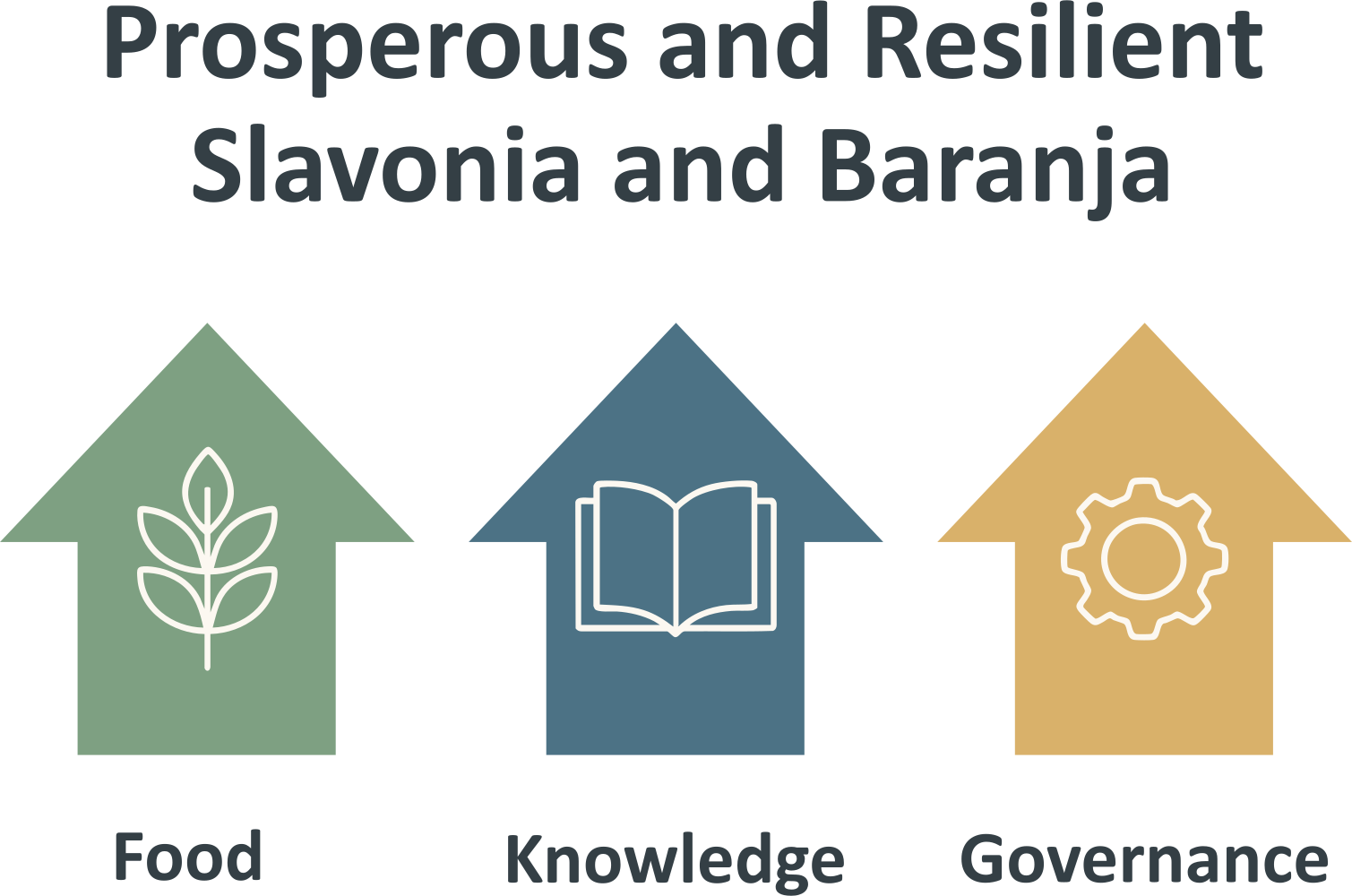
Aligned with the strategic priorities of the European Union for the 2024–2029 period, the Sustainable Europe 2030 agenda, the United Nations 2030 Agenda for Sustainable Development, the European Semester recommendations for Croatia, the National Development Strategy of the Republic of Croatia until 2030, and the Government Programme 2024–2028, the 2026 Scientific Assembly focuses on strengthening the economic resilience of Slavonia and Baranja through an integrated framework built around food, knowledge, and governance.
Food is increasingly recognised as a strategic pillar of economic, social, and cultural resilience rather than solely as an agricultural sector.
Knowledge is the foundation of innovation, competitiveness, and long-term regional development. The effective transfer of knowledge into practice is essential for strengthening regional resilience and creating sustainable economic value.
Governance provides the institutional capacity necessary for resilient communities, effective public administration, strategic investment, and sustainable territorial development.
Together, these three pillars constitute an integrated framework for strengthening regional resilience and enhancing long-term competitiveness.
The Scientific Assembly seeks to foster interdisciplinary dialogue and cross-sector collaboration among researchers, industry leaders, public institutions, and policymakers. Through scientific exchange and evidence-based discussion, the conference aims to contribute to the development of innovative solutions and public policies that enhance the economic strength and resilience of Slavonia and Baranja and support the sustainable development of Croatia.
The Conference welcomes original scientific contributions addressing the following key themes:
Dopušteno je autorsko sudjelovanje u dvama radovima.
Ne, svaki rad može biti prijavljen u samo jedno tematsko područje.
Rok za predaju cjelovitih radova je 12. rujna 2026.
O prihvaćanju/odbijanju radova bit ćete obaviješteni do kraja rujna 2026.
Ne, ponovno slanje rada nije moguće.
Da, pogledajte upute autorima za slanje radova koje su dostupne na mrežnoj stranici https://zssib.hr/index.php/konferencija/upute-autorima
Preporučeni najveći opseg cjelovitog rada je do 8.500 riječi, ne uključujući popis literature, tablice, slike i priloge.. Sažetak na hrvatskom i engleskom jeziku treba imati između 300 i 500 riječi.
Ako je vaš rad prihvaćen za objavu, niste obvezni izlagati rad na Znanstvenom saboru, no preporučujemo da nazočite programskom dijelu Znanstvenog sabora Slavonije i Branje. Tada ste obvezni registrirati se.
Molimo, kontaktirajte organizacijski tim konferencije na zssib@zssib.hr.
Ako želite nazočiti programskom dijelu Znanstvenog sabora Slavonije i Baranje, obvezni ste se registrirati. Registracija je odvojena od postupka predaje rada. Molimo Vas da se prijavite na vrijeme kako biste se smatrali registriranim na događanja i aktivnosti Znanstvenog sabora.
Molimo, obavijestite organizacijski tim na zssib@zssib.hr.
Da, svaki će registrirani sudionik koji je nazočio programskom dijelu Znanstvenog sabora Slavonije i Baranje dobiti potvrdu o dolasku na Znanstveni sabor Slavonije i Baranje.
Da, radovi prihvaćeni za objavu bit će objavljeni u Zborniku sa Znanstvenog sabora Slavonije i Baranje u izdanju Hrvatske akademije znanosti i umjetnosti.
Svaki prijavljeni rad prolazi proces slijepe recenzije, na temelju kojeg će rad biti prihvaćen ili odbijen za objavu.
Na mrežnoj stranici Znanstvenog sabora Slavonije i Baranje nalazi se popis članova organizacijskog i znanstvenog te počasnog odbora Znanstvenog sabora.
Molimo, pogledajte odjeljak „Informacije o putovanju i smještaju“ na mrežnoj stranici Znanstvenog sabora Slavonije i Baranje (link).
Aktivnosti na Znanstvenom saboru Slavonije i Baranje odvijaju se uživo, licem u lice (on-site event).
Ove godine plaća se kotizacija za Znanstveni sabor Slavonije i Baranje.
Ne, nazočnost na Znanstvenom saboru Slavonije i Baranje nije ograničena samo za članove akademske zajednice, nego potiče uključivanje svih zainteresiranih dionika iz područja znanosti, lokalne uprave i samouprave i industrije.
Da, studenti su dobrodošli nazočiti programskom dijelu Znanstvenog sabora Slavonije i Baranje uz prethodnu prijavu poveznicom.
Ako znanstveni rad pišete u suautorstvu s mentorom ili profesorom, dobrodošli ste poslati prijavu rada.


